One rhythm, never a score
Build Rhythm
Build Rhythm reveals when my making bunches up and when it goes quiet. It cannot tell me whether a busy day was productive or whether a large change was good. Those limits are the reason the page keeps one clock and its exact table in view, and the reason the two token clocks that once sat beside it are gone.
Reading question What can an activity trace help me notice without pretending to measure the quality of the work?
The conclusion
The shape is useful; the score would be fiction.
Bursts can help me remember a release, a deadline, or a long iteration loop. Quiet stretches can prompt a question. Neither one ranks the work. I use the chart to find a moment worth inspecting, then use the table and source record to see what was actually counted.
Two questions, one clock
The chart answers two questions at the reading speed its evidence can support. The live explorer keeps the exact, keyboard-readable table immediately behind the visual summary.
-
Code cadence
When did the code work bunch up?
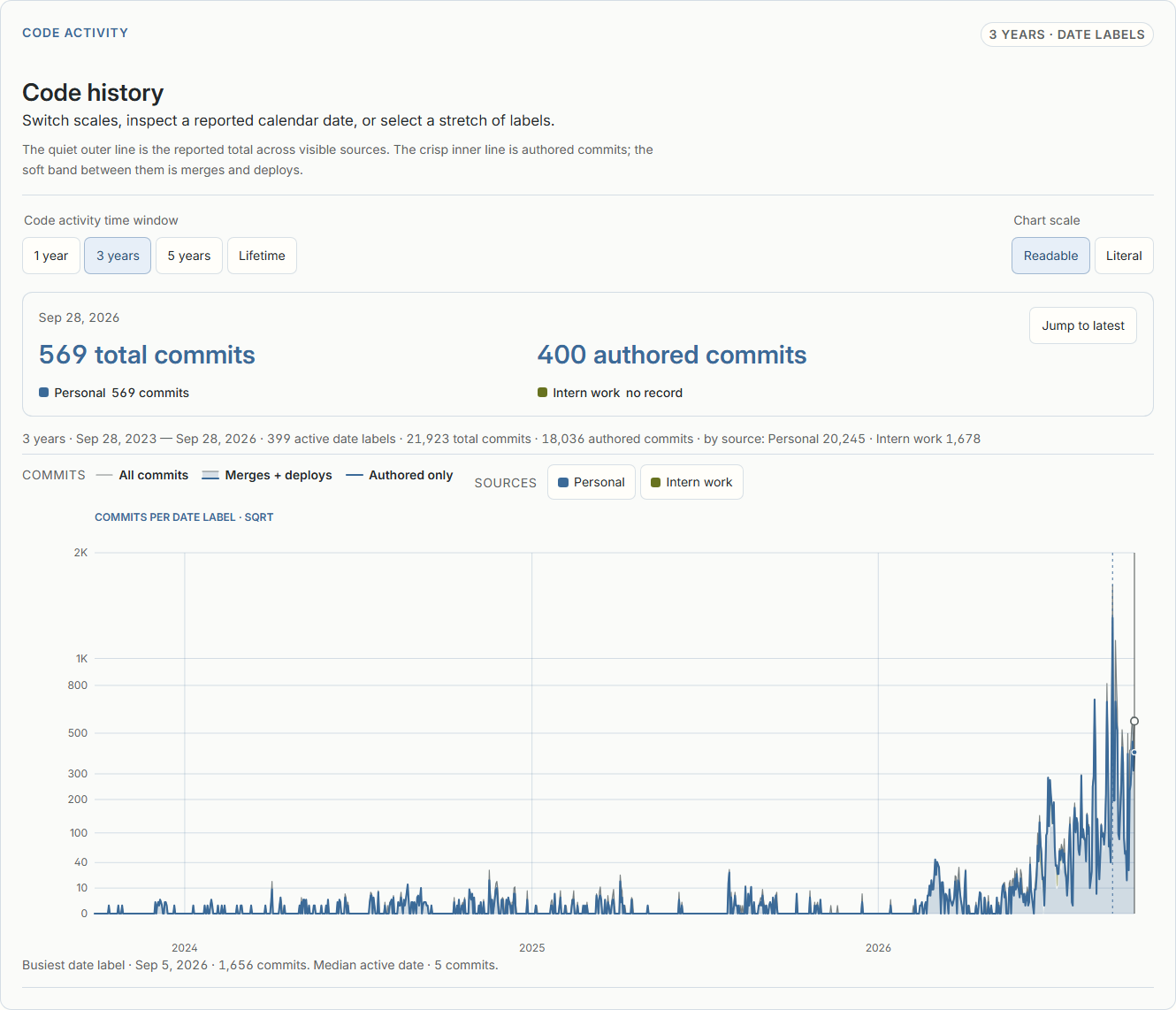
Reported commits mark active calendar labels. The quiet outer line is the reported total across visible sources. The crisp inner line is authored commits, and the soft band between them is merges and deploys.
It cannot establish: time spent, difficulty, quality, or whether a large diff mattered more.
-
Readable detail
What happens between the biggest bursts?
The commit chart now has the whole plotting area. Readable uses a square-root scale, giving larger bursts more room while keeping small counts visible. Literal restores the full distance to the biggest spike. Both plot the same reported values.
It cannot establish: whether a large change was good, how long it took, or what caused a burst.
I removed the additions and deletions chart because repository text churn was drawing attention away from the rhythm I wanted to see. The website and GitHub profile now give that space to commits.
Why the pacing changed
John Thompson shared The Rhythm of Food during a design session on balancing performance, interactivity, and effort across SVG, Canvas, and WebGL. The lesson I carried over was pacing: make one relationship legible, then let the reader inspect the record. I used that principle without copying its visual language or implementation.
Receipts: how the clocks came and went
An earlier version put GitHub activity and source-linked token history in one workbench. They looked like one story even though they used different evidence and clocks. Later versions pulled them apart, and on September 8, 2026 the token clocks left the page for good: the site-build estimate could only see one machine's retained logs, and once every agent user has billions of tokens the total stopped saying anything.
-
First version
I started with GitHub weeks.
The GitHub-only workbench at
b4203f3eamade ordinary weeks visible: commits for cadence, line changes for scale.71b8f4c89then placed Codex history beside it. -
What went wrong
The side-by-side view blurred two different clocks.
ed0d3ba40pulled the GitHub and Codex views apart. At7e224db12, the public account view became one rounded checkpoint instead of a history that could expose its sources. -
What stayed
One clock remained once the tokens stopped saying anything.
6edea07f4brought back this site's rounded daily token estimate as a separate series, and the code explorer later carried completed personal agent days in an independently dated inset. On September 8, 2026 I removed both token clocks. The estimate saw one machine's retained Codex logs, so it undercounted the Claude work that built much of this site, and the tally of commits included the commits that refreshed the tally. The code explorer kept every interaction.
Receipts: full data and revision record
Hero evidence: the current screenshot is a live capture of the code-history explorer on September 29, 2026 at 1440 by 1000 in the light theme, three-year window, readable scale, latest label pinned. It uses the newly verified personal record through September 28 and preserves the intern source's declared coverage. Page navigation and the floating companion are hidden for this content-only capture.
Data contract: One signal, never a score. Code history appears only after exact source-calendar coverage validates for every named source. The current schema carries only total and authored commits; the older four-metric schema remains readable during migration. Personal uses GitHub profile author-date labels completed in America/Los_Angeles; contributed feeds use UTC labels, so matching labels do not pretend to be one shared 24-hour window. The website plots days and the GitHub profile groups the same personal history by week. GitHub's broader contribution total also includes activities such as pull requests, issues and reviews.
-
b4203f3eaIntroduced the activity view with keyboard inspection, an exact table, and a privacy-safe fallback. -
71b8f4c89Added Codex token history beside the GitHub view, creating the crowded state that the next revision separated. -
ed0d3ba40Separated the Codex and GitHub horizons after one overview implied a relationship the data could not support. -
d3f13be35Removed causal and cost clutter so the evidence returned to cadence and change. -
1b07cea4cRestored additions and deletions with readable and literal scales plus stronger responsive evidence. -
6b4b7bd59Added a scroll-led reading that teaches cadence, magnitude, scale, and the separate Codex clock before handing control to the exact explorer. -
7e224db12Replaced source-level account history with one identity-free direct checkpoint. -
6edea07f4Restored the rounded repo-scoped token estimate as a separate series within the public boundary. -
90e9f613bMoved the encoding key into an HTML strip with the profile SVG's words, plainer panel headings, an olive intern band with a seam, and per-source readout cells. - Retired both token clocks and their pipelines; the page now reads code cadence and change only, with a live capture as its hero.
- Removed line-change metrics from the website and GitHub profile, giving commits the full chart height and finer logarithmic ticks.
- Retired diff collection, refreshed the complete personal record, and changed Readable to a square-root scale so growing commit bursts remain distinguishable.
Credits
The Rhythm of Food was made by Google News Lab and Truth & Beauty. Thanks to John Thompson for sharing it and starting the conversation about storytelling across web rendering systems.