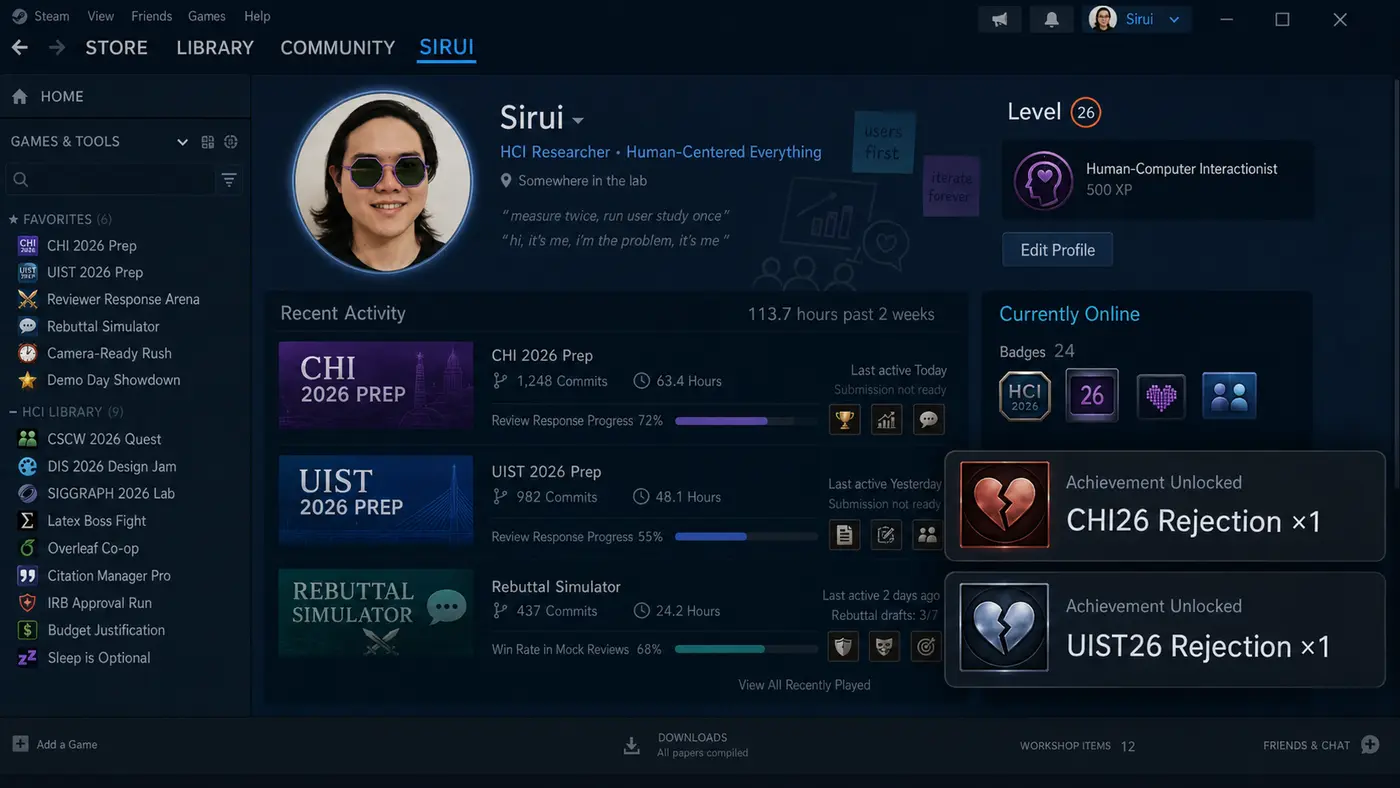
Wall of Rejection
Selected badges for papers, grants, and fellowships that did not land yet.
Curated shelf
Papers
Funding
CHI
UIST
Microsoft Research
CHI Rejection x1
R&R decision / Jan 15, 2026
CHI 2026 did not accept this paper. The reviews now guide the next draft.
UIST Rejection x1
First review / May 28, 2026
The system was built and submitted. UIST said no, so the next version gets clearer.
First Grant Rejection x1
Grant/proposal decision / Jun 15, 2026
MSR AI and the New Future of Work CFP did not land after decisions were delayed to June 15, 2026. The attempt still counts as proposal practice and future-work clarity.
First Fellowship Rejection x1
Fellowship decision / Feb 27, 2026
The MSR Fellowship proposal notification did not land this round on February 27, 2026. The badge marks the first fellowship rejection without making every future no a new card.
Double Rejection x1
Combo badge / May 28, 2026
CHI and UIST both said no. That means the next version gets simpler and stronger.
Inspired by Bradley Voytek's failure-CV tradition, Sirui's and the Spooder-Man meme.
Paper List shown.
2026
-
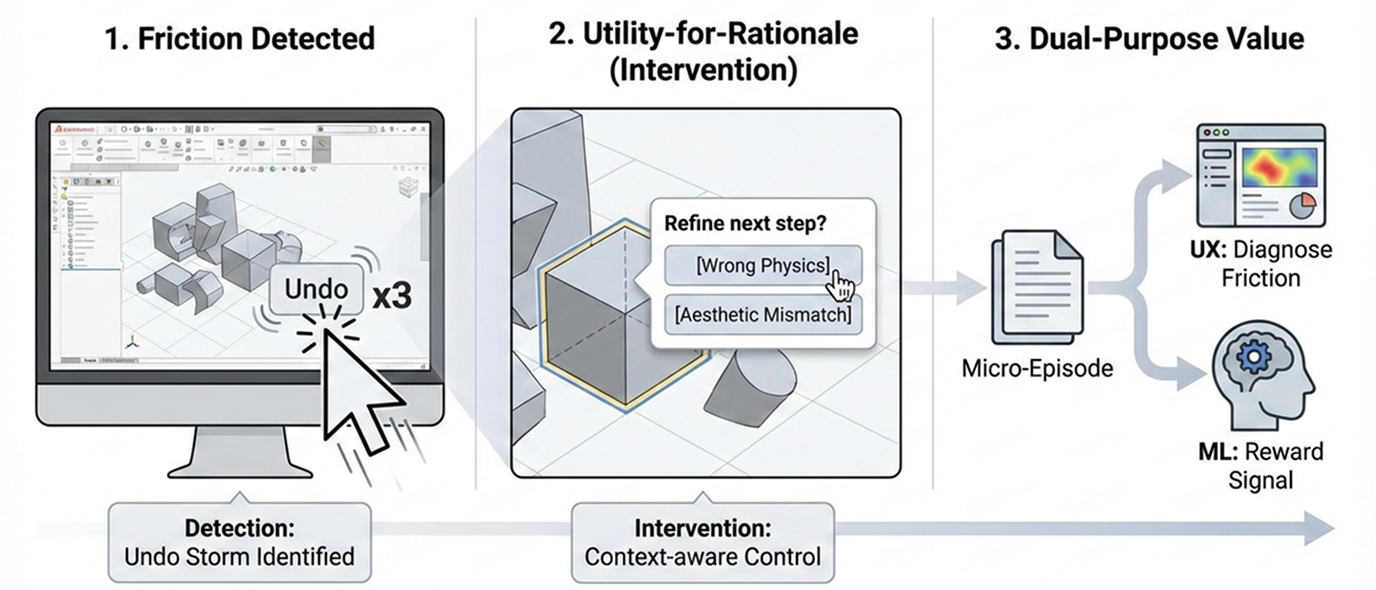 In Herding CATs: Making Sense of Creative Activity Traces (CHI 2026 Workshop), Apr 2026Workshop Position Paper
What Happened and Why? Trace-Guided Micro-Episodes with Elicited User Explanations for Product Iteration: When this paper helps.
This paper helps when you can see what someone did in an AI tool but still cannot tell what that action meant to them.
Look for- You are designing lightweight feedback at the moment a creative workflow becomes ambiguous.
- You need a unit of analysis that joins a short trace, interface state, and a user's optional explanation.
It addsA proposal for trace-guided micro-episodes and a utility-for-rationale pattern that turns useful recovery controls into chances to learn why something happened.
Its limitIt is a position paper and research agenda, not an empirical validation of the interventions or their downstream effects.
I checked this against the paper and its official record on 2026-07-13.
Read the full evidence and citation context

2025
-
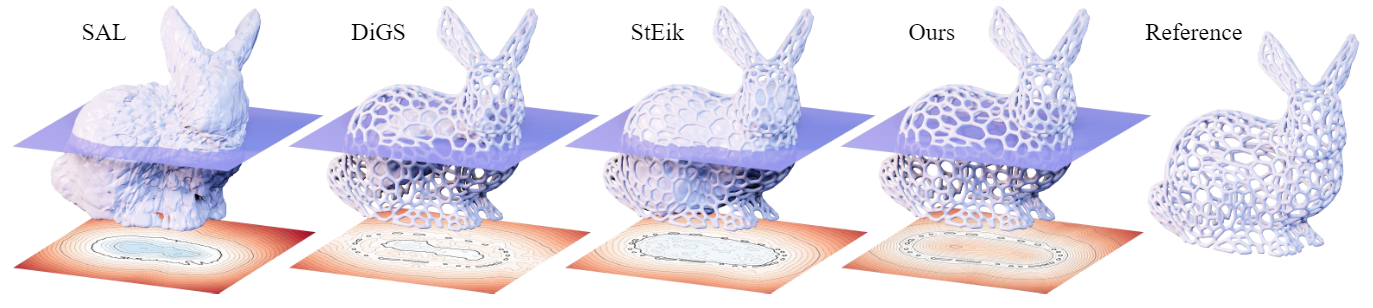 CVPR Full paper Coauthor 20 citesIn Proceedings of the IEEE/CVF Conference on Computer Vision and Pattern Recognition (CVPR), Jun 2025CVPR 2025 Highlight
HotSpot: Signed Distance Function Optimization with an Asymptotically Sufficient Condition: When this paper helps.
This paper helps when an implicit-surface argument needs more than the usual eikonal condition—especially around convergence, stability, topology, or surface area.
Look for- You are comparing objectives for reconstructing signed distance functions from unoriented points.
- You need theoretical and experimental evidence about a screened-Poisson alternative.
It addsA heat-loss objective with convergence and stability analysis, plus 2D and 3D reconstruction evidence and a natural surface-area penalty.
Its limitThe reported gains belong to the evaluated reconstruction settings; sparse boundaries and parameter choices can still produce failure modes.
I checked this against the paper and its official record on 2026-07-13.
Read the full evidence and citation context -
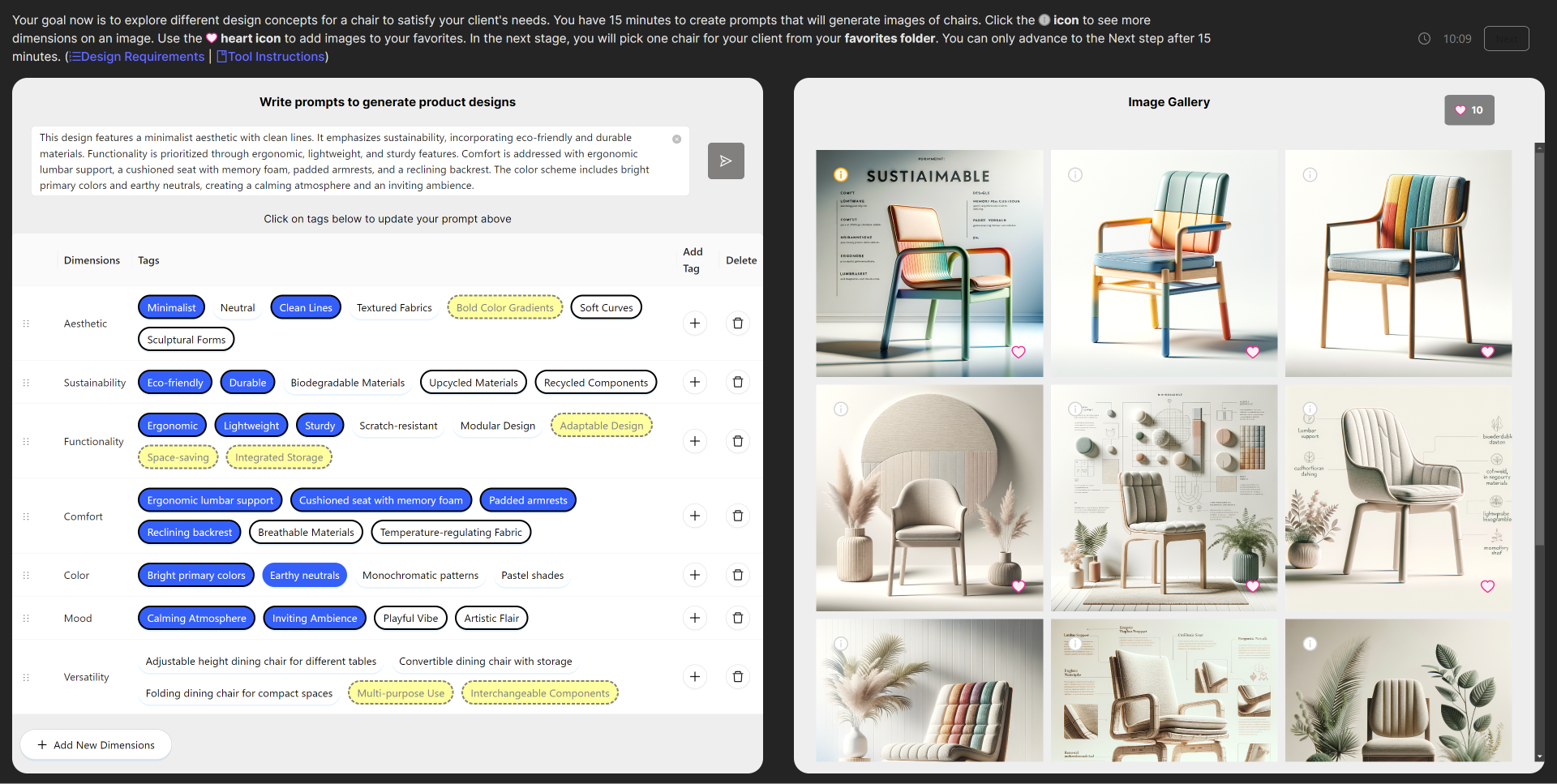 CHI Full paper First author 52 citesIn Proceedings of the 2025 CHI Conference on Human Factors in Computing Systems, Apr 2025
DesignWeaver: Dimensional Scaffolding for Text-to-Image Product Design: When this paper helps.
This paper helps when a blank prompt box is asking novices to supply design vocabulary they have not had a chance to learn.
Look for- You are designing dimensional scaffolds for text-to-image exploration.
- You want evidence about prompt language, visual diversity, novelty, and rising expectations.
It addsA palette that externalizes product-design dimensions, grounded in expert practice and evaluated with 52 novice designers.
Its limitThe study used one chair-design task with novices, and richer prompts did not reliably improve satisfaction or expectation alignment.
I checked this against the paper and its official record on 2026-07-13.
Read the full evidence and citation context


2023
-
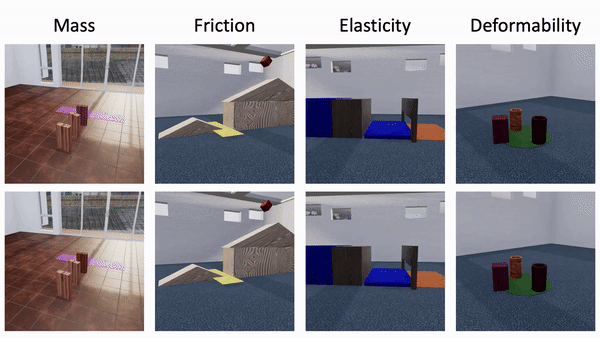 CogSci Short form Poster + abstract Coauthor 0 citesIn Proceedings of the Annual Meeting of the Cognitive Science Society, Jul 2023Poster with abstract
Physion++: Evaluating Physical Scene Understanding with Objects Consisting of Different Physical Attributes in Humans and Machines: When this paper helps.
This paper helps when physical prediction depends on inferring hidden material properties from motion rather than receiving those properties directly.
Look for- You are comparing human and model adaptation to mass, friction, elasticity, or deformability.
- You need the exact CogSci record for Physion++ rather than the separate NeurIPS technical paper.
It addsA benchmark framing for latent-property inference and matched human–model prediction under changing mechanical properties.
Its limitThe public CogSci record supports qualitative claims from the abstract, not detailed quantitative claims from the companion paper.
I checked this against the paper and its official record on 2026-07-13.
Read the full evidence and citation context

2021
-
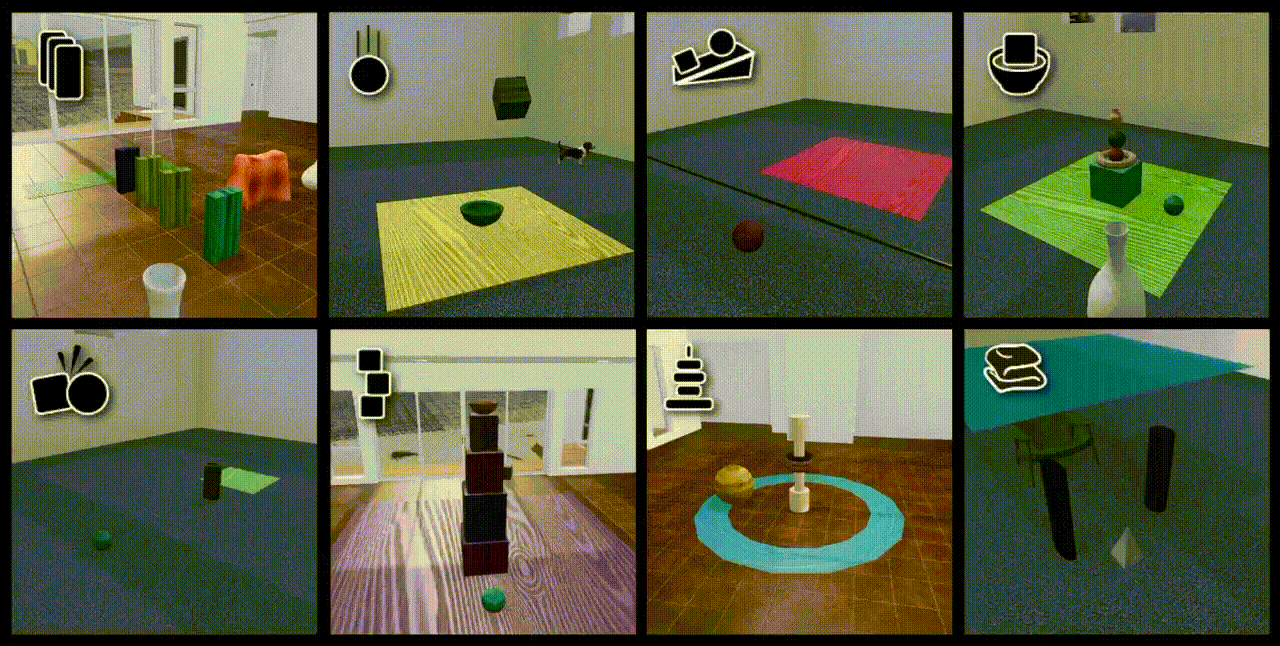 NeurIPS Full paper Coauthor 229 citesIn Proceedings of the Neural Information Processing Systems Track on Datasets and Benchmarks, Dec 2021
Physion: Evaluating Physical Prediction from Vision in Humans and Machines: When this paper helps.
This paper helps when you need a reproducible benchmark for asking whether a model predicts physical outcomes in human-like ways.
Look for- You are comparing object-centric and non-object-centric visual models with human judgments.
- You need a common contact-prediction task across several simulated physical scenarios.
It addsEight scenario families, matched human and model evaluation, and released data and code for systematic comparison.
Its limitSynthetic scenes and binary contact prediction do not establish broad real-world physical understanding.
I checked this against the paper and its official record on 2026-07-13.
Read the full evidence and citation context

Research lineage
Paper Constellation
Follow the research threads that connect the published work, then look ahead without turning work in progress into a publication claim.
A thematic bridgeFrom a design choice to its explanation
DesignWeaver makes dimensions available during creation. What Happened and Why? asks how interaction evidence can help explain design decisions. These are connected questions, not a direct system extension.
- DesignWeaver2025
- What Happened and Why?2026
Larger question marks hint at nearer-term work. Smaller marks hold space for earlier-stage directions.
In progress
Larger marks are nearer-term; every node stays anonymous until the work is public.
Hover or focus to trace its neighborhood. Select it to keep the evidence open.
2026 · CHI WS · 0 citations
What Happened and Why? Trace-Guided Micro-Episodes with Elicited User Explanations for Product Iteration
A position paper proposing trace-guided micro-episodes that pair short interaction-trace windows and interface state with optional, in-flow user clarification so teams can interpret ambiguous behavior in creative AI tools.
2025 · CVPR · 20 citations
HotSpot: Signed Distance Function Optimization with an Asymptotically Sufficient Condition
HotSpot uses a screened-Poisson heat loss as an asymptotically sufficient condition for neural signed-distance-function optimization, improving stability while naturally penalizing excess surface area.
Technical graphics adjacency, not an interaction-study claim.
2025 · CHI · 52 citations
DesignWeaver: Dimensional Scaffolding for Text-to-Image Product Design
DesignWeaver turns dimensions derived from design briefs and generated images into a selectable palette that helps novice product designers write richer prompts and explore a broader text-to-image design space.
2023 · CogSci · 0 citations
Physion++: Evaluating Physical Scene Understanding with Objects Consisting of Different Physical Attributes in Humans and Machines
Physion++ evaluates physical prediction when mass, friction, elasticity, and deformability must be inferred online from how objects move and interact.
2021 · NeurIPS · 229 citations
Physion: Evaluating Physical Prediction from Vision in Humans and Machines
Physion provides eight simulated scenario families and a model-agnostic object-contact prediction task for directly comparing human and model physical prediction.
Interaction approach inspired by Royal Constellations by Nadieh Bremer / Visual Cinnamon ; thanks to John Thompson for sharing the reference. Read the original process story.
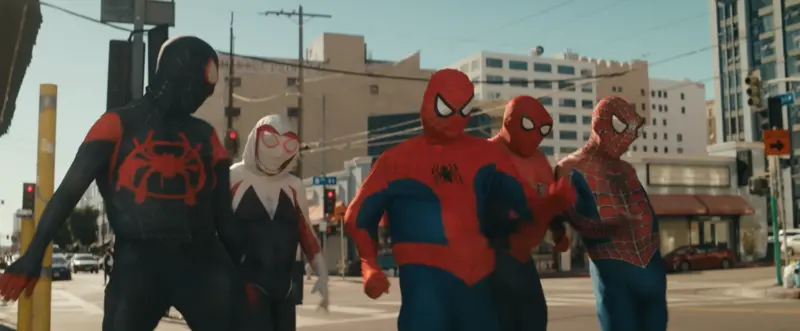
Spooder-Verse
Join the nerdy Spooder-Verse.
Bring one real academic no; use the prompt and assets to make your own remix.