Site experiment · first seen June 17, 2026
The Desk That Learned Depth
The homepage desk is one set of objects in two views. The 2D collage starts with my portrait, papers, and records; 3D opens an inhabited coastal home. Five cartoon versions of me share its daily rhythm, while the music and discoveries stay with you between views.
I wanted the paper desk to feel like a place without making the quick 2D homepage slower to read.
A quick 2D desk and an inhabited home with six connected spaces, sharing the same records, papers, and discoveries.
Switch views, play a record, find a hidden card, and check that it is still there when you switch back.
September: a home with a daily rhythm
The room now has a study, kitchen, gym, onsen, ocean terrace, and sleeping alcove. An authored San Diego routine moves me between them: breakfast comes late, coding continues into the night, and the onsen faces the Pacific. It is a little imagined day, not a live location feed.
I kept 2D as the first view on every screen. In 3D, the occupied room follows the routine; Look around takes you out to the coast. I am refining the Realistic treatment, with stone, warm wood, and moving water. Architectural and Illustrated are deferred experiments in the authoring lab. The cliff and ocean remain actual parts of the world when you look around.
The first character pass did not look enough like me. Reviewing it against my portrait led to an exposed forehead, swept-back long hair, wire glasses, and a broader Lizard jaw. Likeness and the small gestures remain things to judge in the rendered scene, not just in a concept board.
A small floating companion, P, now wanders between the room and the reading page. P means Prototype, with a nod to ProtoLab. Its project page has a motion playground and credits for the robot references that shaped it.
Why the desk has two views
I liked how quickly the 2D collage introduced the papers, portrait, and records, but I also wanted visitors to wander through that little world. The first 3D version copied the desk into a small stage. At ordinary screen sizes, furniture disappeared, dropped cards floated, rear turns exposed blank space, and the outside looked like a separate dollhouse.
The fix was not more decoration. I made inside and outside two camera views of the same room, then shared the record player and discoveries with the 2D desk.
Two eras, four frames
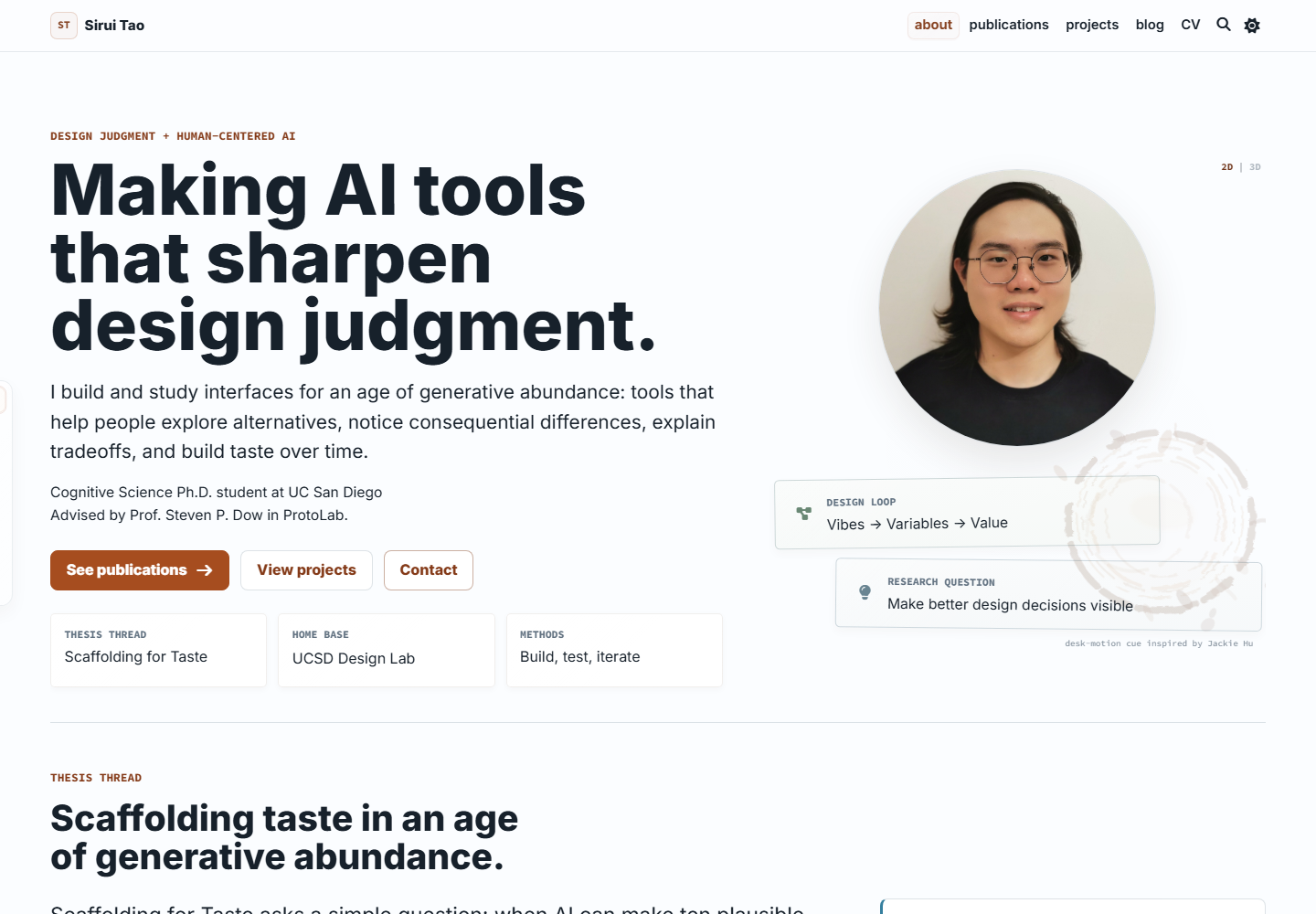
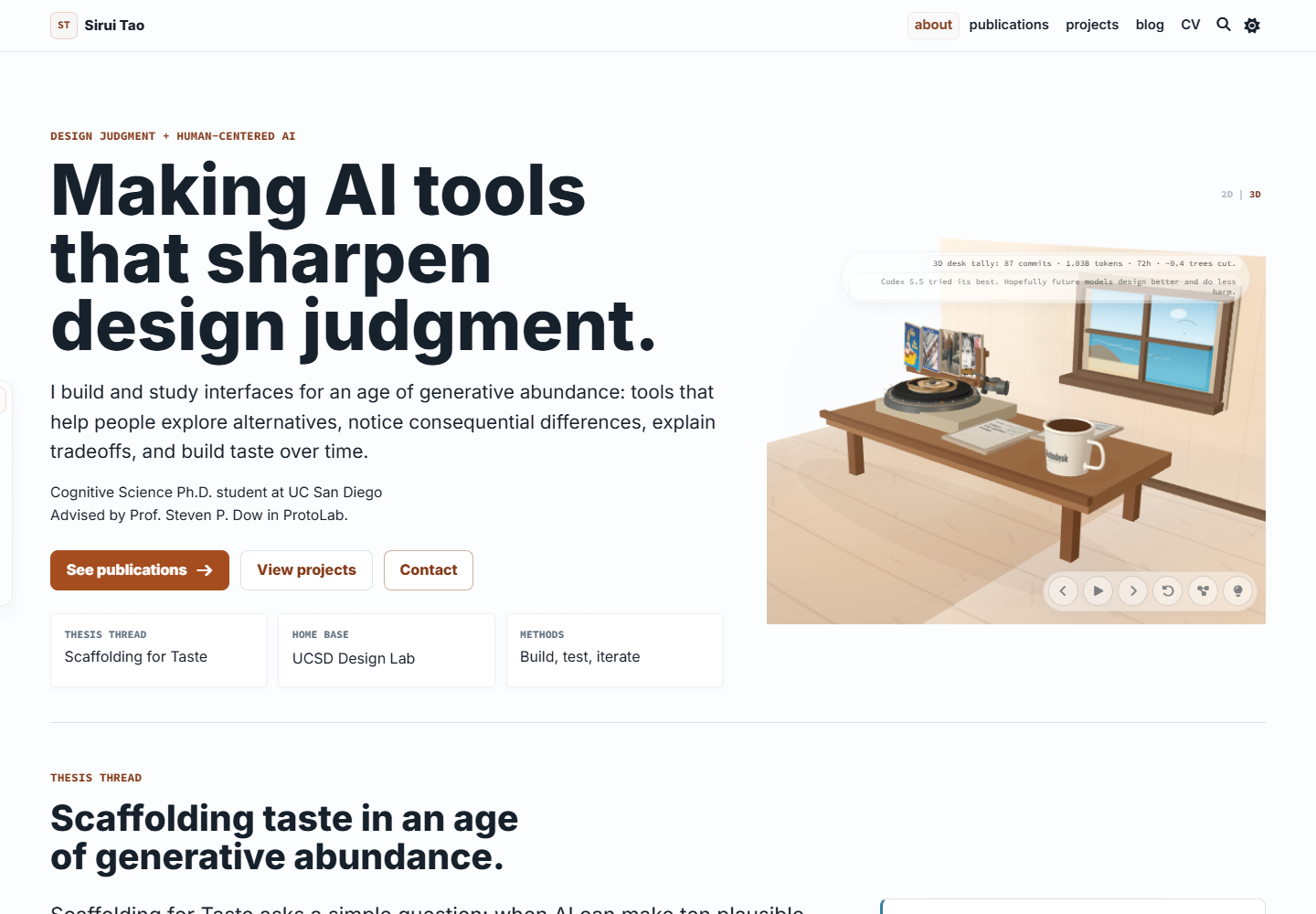
The four frames hold everything I could keep constant: the same route, 1440 × 1000 viewport, light theme, Yellow Submarine stopped, and an empty discovery pile. Each pair starts in 2D and changes only the view. The June pair is an exact-commit replay; the July pair is the accepted checkpoint.
GPT-5.5 / xhigh provenance
June 21: the first room
Source 588e36509 · captured July 16
The collage already read well. The 3D view was a small stage sitting inside a black field.
GPT-5.6 Sol/ultra provenance
July 16: one room, viewed from both sides
Runtime source 8fc9bf7d3 · accepted scene 1b07cea4c
The 2D state now carries into the same room viewed from inside or outside. Yellow Submarine remains queued and the discovery pile remains empty in both frames.
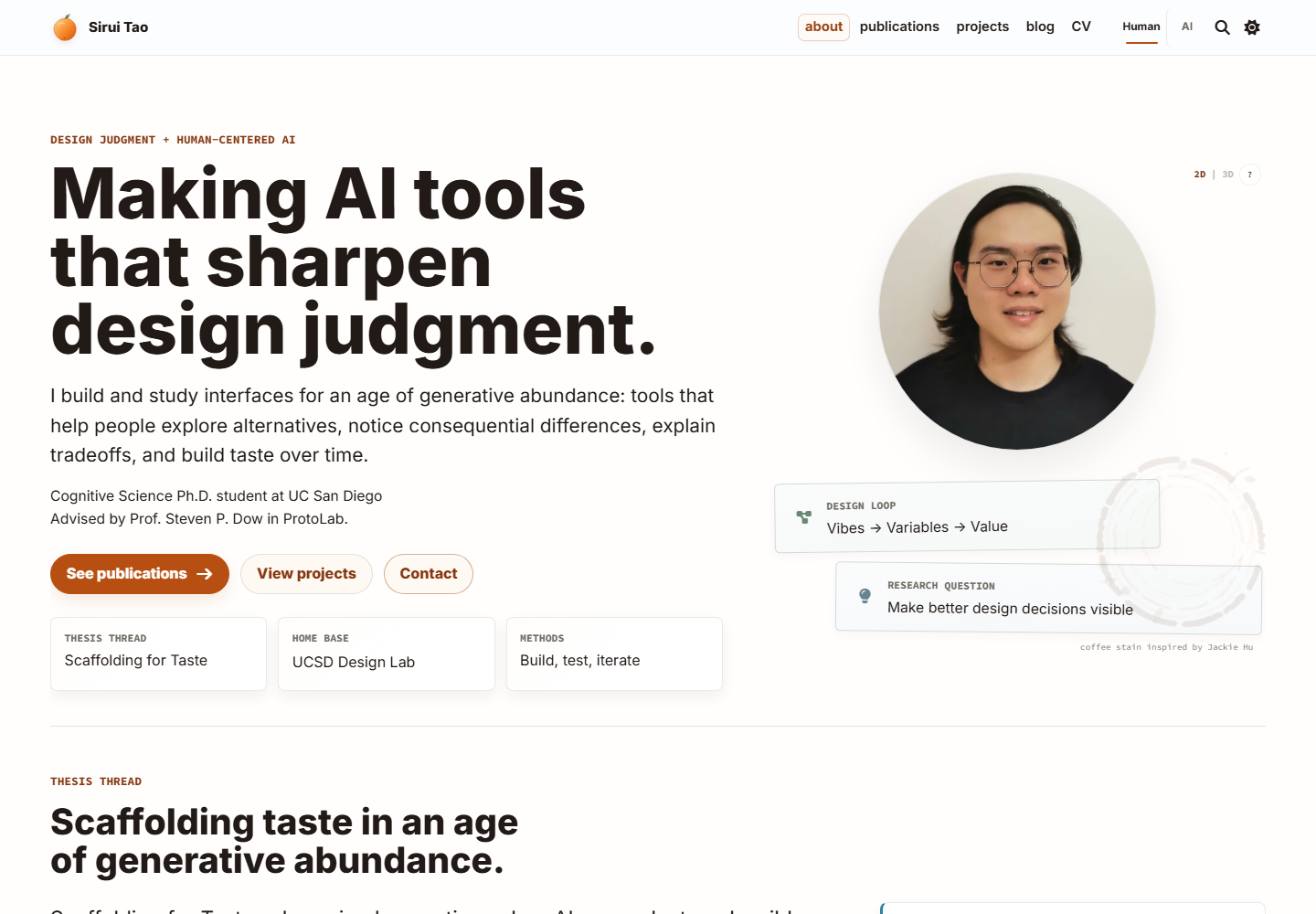
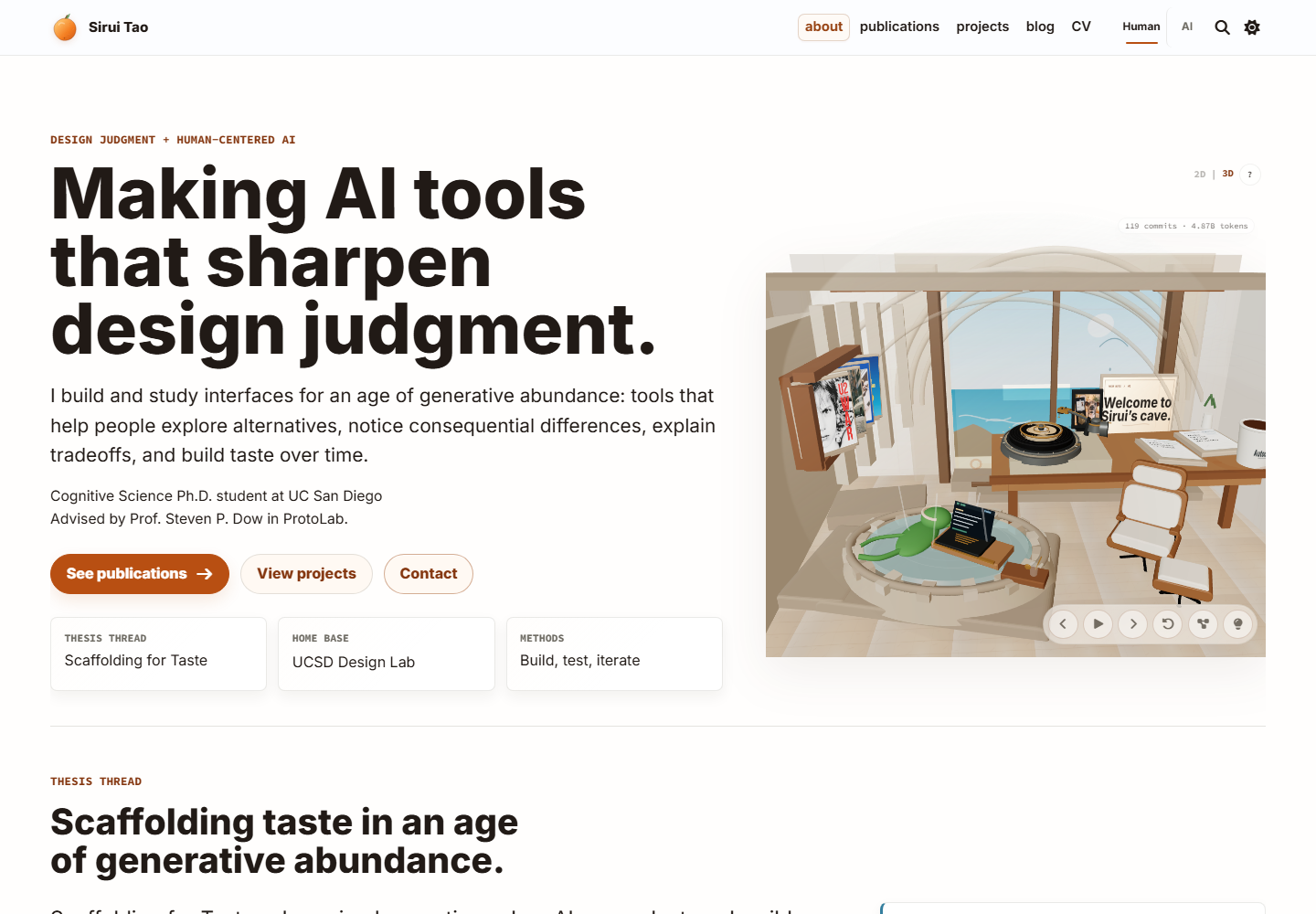
The labels record the model context for each era; this is a comparison of design history rather than isolated model performance. The prompt, retained context, task, implementation history, and my critique all changed too. “Codex 5.5 tried its best” remains visible because it belonged to the June interface.
The July decisions
The visible 2D | 3D switch, shared music and discoveries, paper-and-record identity, and clear ways to look outside and return.
The shallow stage, hand-matched exterior miniature, floating-card recovery, and camera framing that hid the furniture.
Keep the room shape, then test the stone, lighting, materials, and controls on more phones and high-DPI laptops.
Technical provenance and checkpoint ledger
The interaction-state contract is shared. Renderer metadata remains intentionally asymmetric because only the July checkpoint recorded the higher-DPR buffer policy.
- Common rubric: homepage route, 1440 × 1000 viewport, light theme, and default 2D or 3D view.
- June replay: exact source
588e36509, one fresh Chromium 145 context, Yellow Submarine stopped, zero discoveries, 2D then mode switch only, device-pixel ratio 1, no console or page errors. - July detail: runtime source
8fc9bf7d3carried Yellow Submarine stopped, zero discoveries, a simulated device-pixel ratio of 3, and a WebGL buffer capped near 2×. The reciprocal architecture was accepted in1b07cea4c. - Interpretation: GPT-5.5/xhigh and GPT-5.6 Sol/ultra record the model context for each era; the comparison evaluates the resulting design history.
-
c8ed8e5daAdded the visible 2D | 3D switch and the first Three.js desk room during the GPT-5.5/xhigh provenance period. -
588e36509Created an artifact/evidence checkpoint with 2D, room, outside, zoom, and album-state captures. -
840a3e1cbDuring the GPT-5.6 Sol/ultra provenance period, rebuilt anchors, rear-orbit clearance, compact framing, raycasts, and grounded card recovery. -
a765c5291Replaced the hand-matched exterior miniature with the actual room graph under reciprocal cameras. -
1b07cea4cAccepted the organic room shell, high cliff aperture, welcome and window cues, and live-geometry/raycast evidence across the full matrix. Material realism remains open headroom. -
2ffd379afStabilized window-hit bounds, canvas click suppression, and deterministic reset tests after visual acceptance.
Credit and provenance
The desk’s playful artifact language adapts an interaction lesson from Jackie Hu’s portfolio: small objects should reveal something real about the person. The room, assets, state model, and implementation are original to this site.