Site experiment · Publication orientation
Paper Constellation
Paper Constellation is a second way to browse my publications. It connects five accepted papers through three questions I keep returning to—Design, Evaluate, and Situate—while future projects stay anonymous. On desktop it is an atlas; on a phone it becomes a chronological trail.
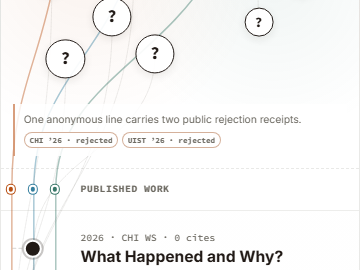
The publication list showed what I published, but not why one paper sits near another.
I reviewed nine connections across five accepted papers and added seven anonymous future nodes.
The same graph becomes a spatial atlas on wide screens and a vertical thread trail on phones.
How the map took shape
-
Starting point
The bibliography had the papers, but not the through-line.
I could answer “what did you publish?” but not “which question kept following you into the next paper?” The first map put those recurring questions on the page.
-
First mobile attempt
Squeezing the atlas made the constellation disappear.
Desktop had room for clusters and paths. On a phone, the labels crowded the sides and long empty year gaps took over the screen.
-
Current version
Desktop stays an atlas; mobile becomes a trail.
The chronological vertical thread trail keeps the same papers, memberships, nine edges, and privacy boundary, but gives titles enough room to read.
Three recurring research threads
I placed each paper against three questions I keep asking:
- Design: How can we make useful alternatives and dimensions visible?
- Evaluate: What evidence from people, artifacts, or traces should change the next iteration?
- Situate: How should a representation or assistant fit its physical and practical setting?
Citation counts affect only a quiet halo. These are reading aids, not rankings; position does not encode prestige, venue, author order, or impact.
I reviewed the coordinates, thread memberships, and nine connections by hand. Their positions stay fixed, so DesignWeaver, Physion, and HotSpot do not wander between visits or screenshots.
The ordinary bibliography still loads first and keeps every title, author, venue, and link. The constellation is an extra way to read that same record.
Follow one line: DesignWeaver to What Happened and Why
DesignWeaver helps novices notice and reuse visual dimensions hidden inside prompts and generated concepts. I placed it mainly in Design, with a bridge to Evaluate: surfacing alternatives only helps when people can compare and learn from them.
What Happened and Why? asks how traces of creative work might locate consequential moments, then pair those moments with in-flow explanations from the person doing the work. It moves toward Evaluate while keeping a Design bridge. The line between the papers marks a question I kept: what evidence helps a designer make the next iteration more deliberate? It is not evidence that one paper caused the other.
Try hovering or focusing a paper to see its neighbors. Select it to keep that path open and highlight the same paper in Scholar Lens. Filters travel in the other direction too, so the list and map stay on the same paper.
One record, two reading shapes
The first phone version simply compressed the atlas. Labels fought for the sides and empty years dominated the page. The replacement keeps chronology running downward while three colored rails carry the research threads behind each paper.
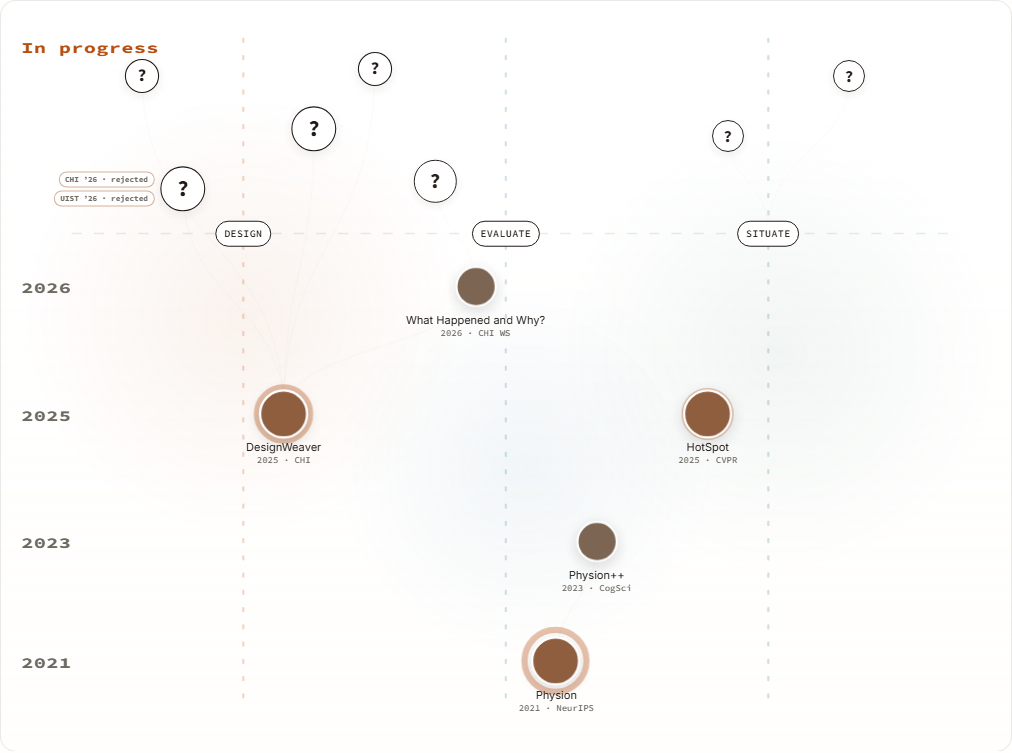
6832a6a05, with the constellation active and no paper pinned. On the live page, select a paper to open its details below; press Escape to close it. The mobile trail keeps the same five papers, seven future nodes, and nine connections.
Credit and adaptation
John Thompson shared Nadieh Bremer’s Royal Constellations with me. Bremer’s work at Visual Cinnamon made a useful interaction lesson vivid: stable semantic structure, contextual dimming, and a neighborhood that becomes legible through focus and selection. Her process story also shows how much care sits behind an apparently effortless map.
I carried over those interaction principles, not the royal-family data, visual layout, assets, D3 force-directed SVG implementation, or shortest-path behavior. This version uses server-rendered HTML and fixed SVG paths, keeps the bibliography complete, and gives touch and keyboard readers the same controls.
Technical provenance and exact ledger
- Privacy-safe data contract:
855f1bce857fc739bf16f206a0d19de10741c0f7, authored . - Desktop implementation and card chronology:
eeb0a57641795897999f822519b390e2c30a7a3b, authored . - Desktop capture: checkpoint
6832a6a05, captured July 16 from a 1440 × 1000 Chromium viewport at device-pixel ratio 1, light theme, constellation active, no paper pinned; cropped to a 1012 × 753 artifact without moving nodes. - Mobile trail checkpoint:
6832a6a05b5ff2b6c692bb3f5e3654a535e4401e, authored . - Mobile capture: checkpoint
6832a6a05, 390 × 1000 source viewport, light theme, constellation active, no paper pinned; cropped to a 360 × 270 card artifact. - Graph contract: five accepted papers, seven anonymous future nodes (three major and four minor), three thread rails, five secondary memberships, and nine explicit nonzero edges.
- Edge semantics: relationships mark reviewed conceptual or technical adjacency. HotSpot's Design–Situate bridge records graphics adjacency rather than an interaction-study claim.
- Interaction contract: hover and focus preview; click or activation pins; Escape clears and restores focus; Scholar Lens filtering, citation-chip focus, and annual-bar focus stay synchronized.
- Layout contract: reviewed desktop coordinates and measured mobile anchors; controls are at least 44 pixels, and a
ResizeObserverredraws paths after layout or font changes without force simulation, random placement, or moving-node animation.