OpenAI Build Week · Education track · July 2026
Scaffolding for Taste
A polished homepage can hide the bad passes and judgment behind it. I wanted students to see what I kept, changed, and threw away, then reuse the same screenshot checks. After the cutoff, I used Codex with GPT-5.6 Sol to add the Human/AI route, Paper Constellation, guided project stories, reproduction briefs, and the tests behind them. The timeline keeps that new work separate from the site I already had.
Before 09:00
Foundation
- Research portfolio
- COGS 125 framing
- Living heuristics
- Reciprocal 3D room
After 09:00
Extension
- Human/AI profile
- Guided evidence stories
- Paper Constellation
- Case studies + QA
I wanted visitors and students to see which design decisions survived review and reuse the checks behind them.
The extension added new reading routes, a publication map, guided case studies, reproduction guides, and responsive checks.
Codex accelerated bounded implementation passes; I reviewed fixed screenshots and decided what to keep, revise, or remove.
What changed after the line?
The timeline below links each public change to its commit. Read left to right by date; the three lanes separate public pages, evidence, and reusable notes.
Selected evidence · date on the horizontal axis
The foundation existed before the cutoff.
The orange rule fixes the eligibility boundary. Equal-sized nodes mark linked checkpoints; horizontal position encodes date.
Equal-sized checkpoint · lane = artifact role · x-position = authored date
-
01 · Draw the boundary
Show what was already there.
The portfolio, COGS 125 framing, living heuristics, first 2D/3D desk, activity workbench, and reciprocal cliff-room topology all predate 9:00 AM. The last named baseline,
a765c5291, was committed before the window opened. -
02 · Make the record readable
Give the same research record two reading routes.
d3f13be35added the source-linked Human/AI research profile, publication catalog, and raw text alternatives. The canonical bibliography owns the facts; the new routes reduce visual decoding work. -
03 · Guide the interpretation
Explain commits, changed lines, and tokens separately.
6b4b7bd59added the scroll-led Build Rhythm story.f05f02b41added the first case-study and reproduction layer, whileb183e4b75wrote the surviving constraints into design memory. The original workbench began on July 11; the guided teaching layer is the Build Week extension. -
04 · Change the representation
Make a desktop atlas and a mobile trail.
855f1bce8fixed the privacy-safe data contract;eeb0a5764built Paper Constellation; and6832a6a05replaced the compressed mobile map with a chronological trail. I reviewed every relationship and coordinate; GPT-5.6 did not discover the research lineage. -
05 · Show the work
Give six earlier experiments and one new paper map their own case studies.
Across
f05f02b41,1ec5d5f4f,2070991b0, and the constellation work, six pre-existing interactions gained project pages alongside the new Paper Constellation. All seven include evidence and downloadable reuse guides. -
06 · Publish the proof
Test more than the best-looking screenshot.
739d2ba28published paired desk evidence under a fixed capture rubric.1ae1ead39andc52de6932closed responsive and cross-engine gaps. The reciprocal room was the baseline; post-cutoff work polished its controls and evidence—it did not create the reciprocal room.
One record, two reading shapes
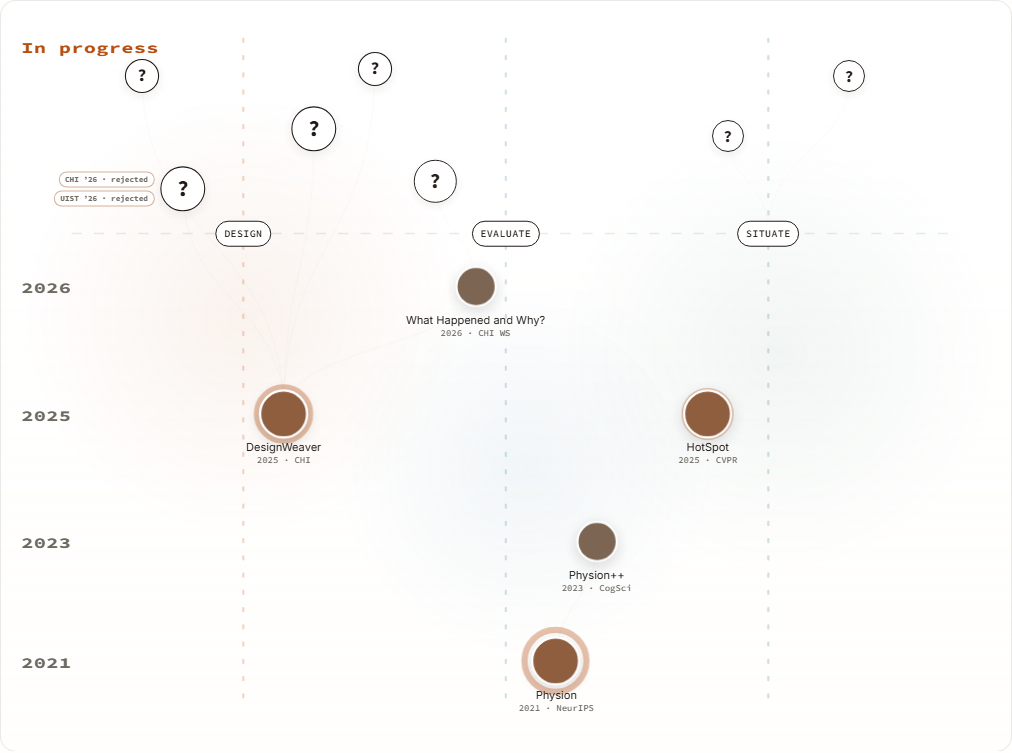
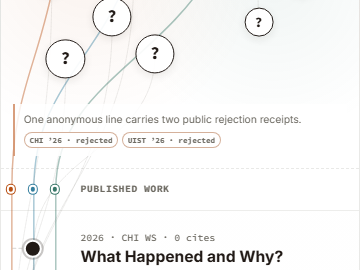
Paper Constellation is the clearest before-and-after within the Build Week extension. Both views use the same five papers, seven anonymous future nodes, three threads, and nine connections. Desktop makes comparison spatial; mobile puts chronology and readable titles first.
Seven experiments got their own case studies
Each page now answers four practical questions: why did I make this, what changed, what evidence survives, and what could someone else reuse?
- Build RhythmSee when building arrived in bursts.
- Paper ConstellationTrace five papers across three questions.
- Homepage deskStep from the paper desk into the same room.
- Project cardsExpand a project without losing its place.
- Scholar LensFollow one paper through its citation history.
- Wall of RejectionOpen each badge to read its rejection receipt.
- Dogtor’s portalFollow a clue through recovery and consent.
How I used Codex during the week
I gave Codex one bounded change at a time, inspected the rendered result, and decided whether it clarified the page. GPT-5.6 Sol made those build-and-review passes faster; it did not make the research or acceptance decisions.
- 01Name the question
Say what a rushed visitor should understand.
- 02Build one change
Use Codex with GPT-5.6 Sol for a bounded implementation pass.
- 03Check the page
Compare fixed routes, viewports, themes, and states.
- 04Decide
Keep, revise, or revert based on meaning and access.
- 05Save the rule
Write useful recurring critique into design memory.
Codex + GPT-5.6 accelerated
The implementation work
- Tracing routes and implementation history
- Building bounded visual and responsive passes
- Writing focused source and browser checks
- Comparing failures across fixed states
Human critique decided
What to keep
- The research claim and eligibility boundary
- Which visual relationships were defensible
- Which directions to simplify or reject
- Which lesson belonged in shared design memory
What another student can reuse
The checklist turns recurring screenshot critiques into checks for hierarchy, mobile layout, accessibility, evidence, and provenance. Students can adapt the checks, then decide which ones improve their own page.
Living design memory
Website design heuristics
A living markdown checklist for critiquing portfolio pages with clarity, restraint, and reflective practice.
Loading heuristics...Exact evidence ledger and Codex provenance
Primary retained build thread: 019f652f-7154-7822-ad1c-daa5a066134b. The retained thread ran GPT-5.6 Sol at ultra reasoning effort. The model label records provenance, not isolated causality; model, prompt, retained context, implementation history, and human critique all changed together.
-
a765c5291Named baseline: reciprocal cliff-room scene committed before the 9:00 AM eligibility line. -
d3f13be35Added the source-linked Human/AI profile, publication catalog, and raw alternatives. -
b183 · 6b4 · f05Recorded durable rules, added the Build Rhythm teaching story, and published the first experiment case studies and reproduction briefs. -
855 · eebFixed the privacy-safe Paper Constellation contract and built the desktop atlas. -
6832a6a05Recomposed the constellation as a chronological mobile trail. -
739 · 1ec · 207Published paired desk evidence and completed provenance-rich experiment stories. -
1ae · c52Closed responsive storytelling gaps and stabilized cross-engine visual checkpoints.
What comes next
Next I want to turn this into a classroom critique exercise with fixed viewports, one shared brief, comparable screenshots, and a worksheet for deciding which observations are worth keeping. Any claim about learning waits for an actual evaluation.
Credits
This page documents work completed for OpenAI Build Week with Codex and GPT-5.6. The site is a customized fork of the open-source al-folio academic theme and uses site-native graphics with static repository evidence.